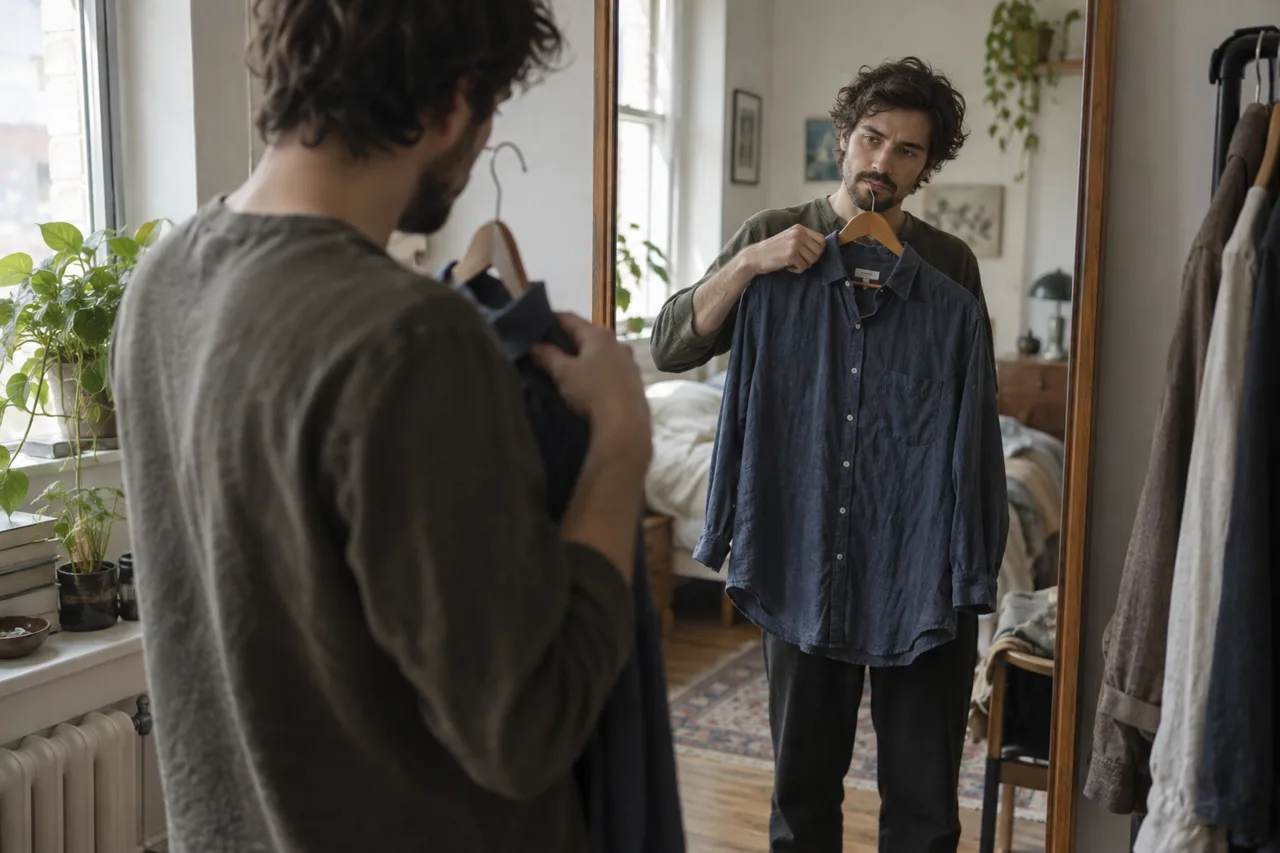
You put on an outfit that looked convincing yesterday and suddenly it feels wrong. Nothing dramatic has happened. The trousers still fit, the shirt is clean, and the weather is similar. Yet you change. That small hesitation is a useful place to begin thinking about personal style, because clothes are experienced in a situation rather than as isolated objects.
This essay explores everyday interpretation and personal preference. It does not claim that a color predicts personality, that an outfit can diagnose a mood, or that dressing a certain way guarantees confidence. Those shortcuts flatten a much more ordinary relationship between clothing, context, and how we want to move through a day.
What are you asking the outfit to do?
Sometimes an outfit feels wrong because it answers the wrong question. You dressed for looking polished, but the day requires carrying groceries and sitting on a train. Or you chose comfort for a quiet morning, then remembered a conversation where you would prefer to feel more deliberate. Neither outfit is inherently better; each serves a different purpose.
Try naming that purpose in plain language. “I want to feel relaxed but ready to speak” is more useful than “I need to look impressive.” “I do not want to adjust my clothes all day” is a clear requirement. A good description gives you something concrete to change.
This does not mean controlling every impression you make. You cannot. Other people bring their own expectations, habits, and biases to what they see. Clothing can be one part of how you present yourself, but it cannot carry the whole responsibility for an interaction.
Is the discomfort physical or interpretive?
Physical discomfort often announces itself through small repeated actions. You pull at a neckline, smooth a waistband, or lift a slipping strap. Before searching for a deeper explanation, check fit, texture, and movement. A garment that demands attention can make an otherwise pleasant outfit feel distracting.
Interpretive discomfort is different. You may worry that a jacket feels too formal for the group or that an outfit looks unlike you. Those impressions are worth noticing, but they are not always instructions to change. Ask whether the concern comes from a stated dress requirement, a known setting, or an assumption you have not examined.
Separate the two on a day when you are not rushed. Wear the outfit around the house or on a low-pressure outing. If it remains physically annoying, solve that problem first. If it becomes more familiar, you may simply have been adjusting to a shape or combination you do not often wear.
First impressions are not a reliable dress formula
People interpret appearance in context, and interpretations can conflict. The same suit might look appropriate in one room and unusually formal in another. A bright color can read as cheerful to one person and distracting to another. There is no universal translation table from garment to character.
For a new setting, look for explicit guidance before making guesses. An invitation, workplace policy, or host’s explanation is more useful than a list of supposed psychological meanings. If the requirement is unclear, asking a practical question is often easier than constructing an outfit around imagined judgment.
Keep room for your own preferences inside the requirement. You might meet a formal dress code through a trouser suit, a dress, or another permitted combination that fits your needs. The purpose of understanding a setting is to make a decision with better information, not to erase every sign of individuality.
Familiar clothes can become a personal shorthand
A reliable shirt may remind you of an ordinary day that went well. A jacket may mark a change in work or a trip you enjoyed. These associations do not have to be profound to matter. Clothes live near routines, places, and people, so it is natural to notice the memories attached to them.
You can use that observation without turning it into a rule. If a familiar combination helps you get out the door with less deliberation, keep it available. If an item now carries an association you do not enjoy, you can store it away, rework its context, or let it go when you are ready.
The weekend wardrobe framework offers a practical counterpart: build around clothes that already serve real situations. Familiarity can be useful, but it should not require you to wear something uncomfortable simply because it used to be your dependable choice.
What about the symbolism people attach to clothes?
Colors, uniforms, heirlooms, and special-occasion garments can carry meanings within families or communities. Those meanings depend on context. A black outfit can be everyday clothing, formalwear, a practical choice, or something connected to mourning. Treating one interpretation as universal makes the clothing less understandable, not more.
The same caution applies when clothes appear in dreams. If you enjoy exploring dream symbolism, treat it as a reflective or cultural exercise rather than a validated psychological assessment. A dream about changing clothes does not establish a hidden fact about your personality or predict what will happen next.
A more grounded question is what the garment means to you in waking life. Was it associated with a particular obligation, memory, or feeling of exposure? You may find an interesting connection, or none at all. You do not need to assign meaning to every item or dream for the reflection to be worthwhile.
A small exercise in noticing
Choose one outfit you often wear and one you tend to avoid. Put each on with the shoes and outer layer you would actually use. Write three observations for each: how it feels physically, what situations it suits, and what you like or dislike visually. Keep the descriptions specific.
Instead of “this is unflattering,” try “I do not like where the jacket ends beside these trousers.” Instead of “I cannot wear color,” try “I prefer this brighter shirt with a quieter bottom half.” Specific language leaves room for a change. Broad judgments can make a single awkward pairing sound like a permanent limitation.
Then change just one element. Alter the layer, shoe, tuck, or accessory and notice what happens. You are not conducting a scientific test; you are reducing the number of moving parts in a personal decision. The exercise is useful if it makes your next morning easier.
Let style remain an ordinary part of life
There will be days when clothing is an enjoyable form of expression and days when it simply needs to be clean and comfortable. Both are legitimate. You do not owe every outing a fully developed visual identity. Repeating a good outfit can be an act of convenience rather than a failure of imagination.
For more demanding situations, practical planning can remove some uncertainty. Thinking through the queue, temperature, and movement in a concert outfit, for example, allows your expressive choices to rest on a workable base. The same principle applies to a meeting, family visit, or trip.
An outfit that feels right usually belongs to the day you are actually having. It leaves you enough room to move, participate, and think about something other than the clothes themselves. That is a useful ambition, even when your taste changes tomorrow.
Practical guidance to adapt to your own needs. Check event requirements with the organizer. Read our editorial standards.